SaaS is dead. Long live SaaS.
That sounds contradictory, but it captures exactly where I think software is going. The opportunity to build a software business is not disappearing. The old formula of building a tool, putting it in the cloud, and charging every person a monthly fee is losing its advantage.
AI is making the tool easier to create. When that happens, the interesting question stops being, “Can you build the software?” It becomes, “What can you help someone accomplish, and what will they pay for that?”
My bet is simple: give away the tool, build an advantage through data and network effects, and charge for intelligence or human services. I call this smart SaaS. And I think it opens up a bigger opportunity than the model it replaces.
Key Takeaways
- AI makes software easier to build, weakening the advantage of charging solely for tool access.
- Smart SaaS pairs free tools with proprietary data, network effects, and paid assistance.
- Revenue can come from token-based agents, completed outcomes, or recurring human services.
- Core tools trend toward free for smaller customers, while enterprise per-seat fees may persist.
How SaaS 1.0 Worked
For roughly 15 years, the SaaS playbook was pretty straightforward.
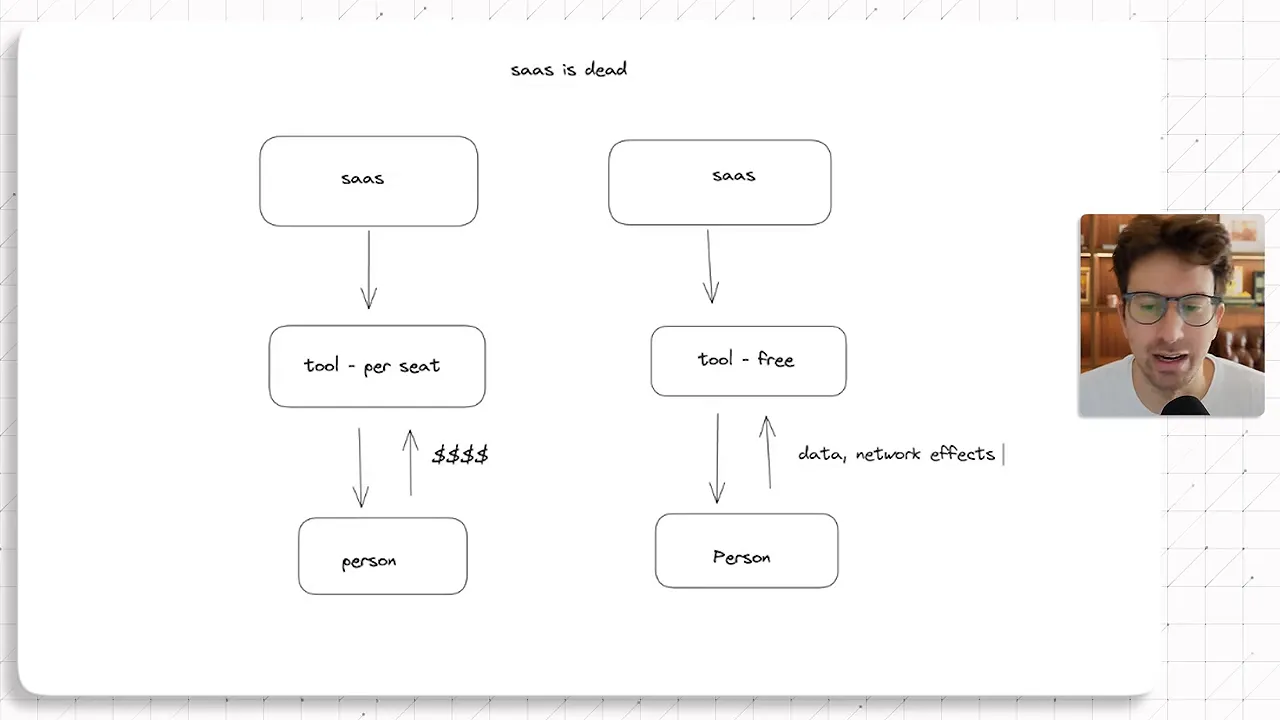
You assembled a group of smart engineers. You paid them to write high-quality code. That code became a useful tool that a human could access through the cloud.
The customer paid for access, usually on a per-seat basis. Maybe it was $9.99 per person. Maybe it was $29.99. More people using the software meant more seats and more revenue.
The basic exchange looked like this:
- The company provided a tool. It did something useful and worked reliably.
- The customer paid for access. Each person using it represented a potential subscription.
- The human did the work. The software helped, but someone still had to operate it.
This was an incredible business model. It created companies worth billions of dollars. Slack is an obvious example of how valuable cloud software could become.
But a big part of that model rested on software being difficult to build. Getting enough talented engineers together and turning an idea into a polished product was a real barrier.
AI changes that equation.
When Building the Tool Gets Easier, the Business Model Changes
Think about the direction AI coding is heading. As models become more capable, the engineering effort required to create a useful application keeps falling.
When I talk about future model generations, whether that is something at the level of Opus 5.5, GPT-6, or whatever comes next, the specific name is not the point. The point is the capability: building the software becomes much less of an obstacle.
Instead of 20 people building a tool without AI, imagine one or two people building it with AI.
That is a very different competitive environment. If the tool itself becomes easier to create, simply having built it is less of an advantage. Charging for access to an ordinary tool becomes a harder proposition when someone else can offer something similar for free.
That is why I do not think the right response is to stop building software. It is to rethink what you give away and what you sell.
SaaS 2.0: Give Away the Tool
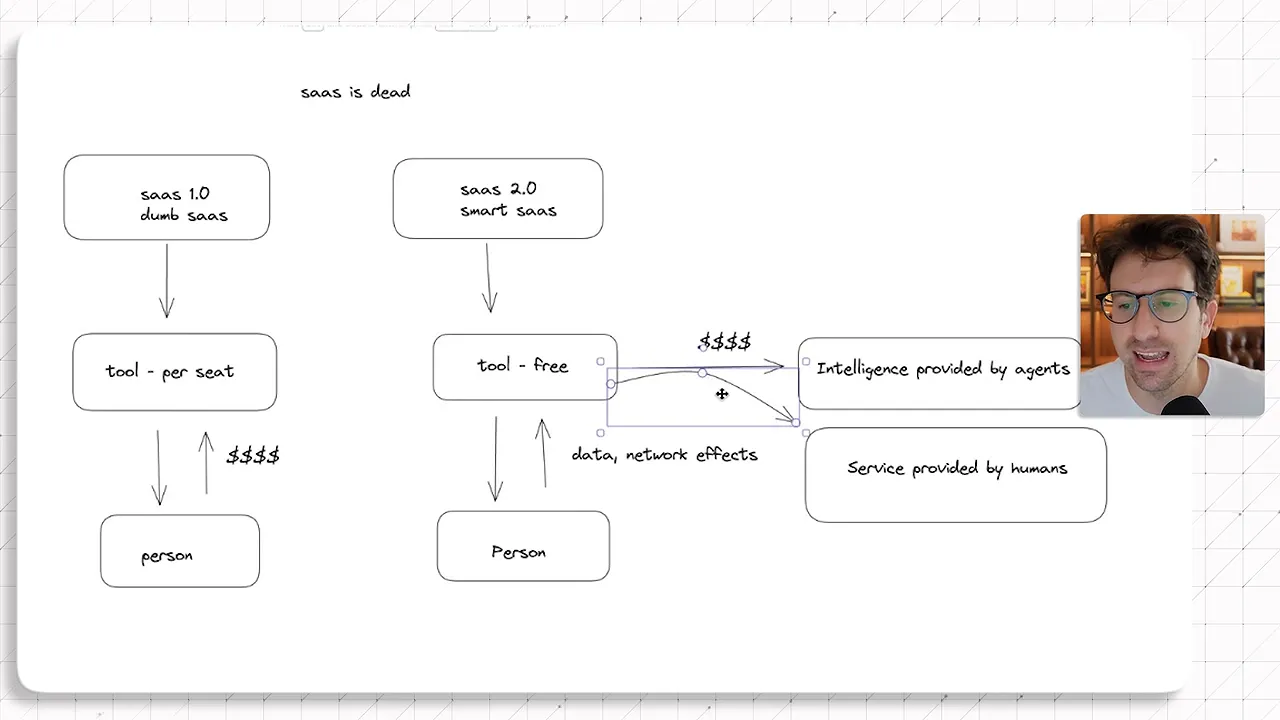
In the new model, you still build a tool. You might use AI to build most of it, or combine AI with a small human team. But instead of making access the core paid product, you give it away.
Give away the CRM. Give away the dashboard. Give away the app.
I do not know why more people are not experimenting with this.
Find a niche where people already pay for a tool under the old model. Then consider what happens if you offer that useful core tool at zero cost.
There is still a value exchange. It just does not start with subscription revenue.
Data becomes part of the value exchange
As people use the product, they contribute data that can help you make it better. Over time, proprietary data can become a meaningful asset rather than something a competitor can reproduce by copying the interface.
That data might improve the tool, support the intelligence you eventually sell, or, where appropriate and permitted, become a separate commercial asset. The important strategic point is that the value is no longer just in the code.
Network effects can help create a moat
The second potential advantage is network effects: the product becomes more valuable as participation grows.
These are not the same thing as collecting data. A useful way to distinguish them is to ask two questions: Does usage help improve the product? And does having more participants make the product more valuable to others?
The goal is not merely to accumulate free accounts. It is to build a product where adoption strengthens the business.
The free tool gets people in. Data and network effects help make the business harder to replace.
Make Money by Upselling Intelligence and Services
Okay, great. The tool is free. How does the company actually make money?
There are two paid layers I find especially interesting:
- Intelligence provided by AI agents. The software does work for the customer rather than simply giving them somewhere to do it.
- Services provided by humans. The customer pays for personal help, expertise, or ongoing support.
This is the distinction between what I call “dumb SaaS” and “smart SaaS.” Dumb SaaS is just a tool. Smart SaaS adds intelligence and execution.
Take a CRM. I can give you the CRM for free. But if you want AI agents to do something useful inside it, that is a paid offering.
The customer is no longer paying only for a place to manage work. They are paying for work to get done. For a deeper explanation of that distinction, Anthropic’s guide to building effective AI agents provides useful context on agents and automated workflows.
The human service layer matters, too. Not every customer wants an agent to handle everything. Some will pay for a person to help them achieve the result.
This is how I think about the idea, discussed by Sequoia, that services are becoming the new software. A software product brings people into the business, and the paid relationship expands into delivering the work itself.
A concrete example: a calorie-tracking app
Imagine a consumer app built around calorie tracking.
Under the old model, you might charge someone a subscription to use the tracker. Under the smart SaaS model, the basic tracker is free, and you offer paid help around the goal that brought them there.
- Free tool: A calorie tracker that gives people a reason to use the product.
- Paid AI intelligence: Agents that create personalized meal plans or help with more precise calorie tracking.
- Paid human service: A weekly weight-management coach who helps the customer stay on track.
These are different levels of help around the same underlying need.
Some people only want the tool. Others want personalized assistance. Others want a real person involved. You do not need to force all three groups into the same subscription.
Three Ways to Charge for Smart SaaS
Making the tool free does not mean everything above it has to use one pricing model. The paid layer can be priced according to what you deliver.
1. Charge by token
For AI agents, one option is token-based pricing. The customer pays based on the AI usage involved in providing the service.
This is a usage-based approach rather than a charge for every person who can open the application.
2. Charge per outcome
Another option is to charge when an agent accomplishes something.
The key distinction is that the customer pays for a completed result, not merely access to the agent. That puts the commercial relationship closer to the reason they wanted the software in the first place.
3. Charge weekly or monthly for human services
For human-delivered services, a weekly or monthly fee can make sense. In the calorie-tracking example, that could be an ongoing relationship with a coach.
The free product and the paid service have different jobs. One brings the customer into the product. The other provides the level of assistance they are willing to pay for.
Why I Think the SaaS Market Gets Bigger, Not Smaller
Per-seat software has a built-in limitation: not everybody wants to pay for a tool.
But a much larger group wants to accomplish something.
That is the opportunity. I think the market for getting things done is bigger than the market for tools people must operate themselves.
Instead of building a product studio around paid subscriptions to standalone tools, imagine building one around free tools. Each tool serves a niche, attracts usage, and creates an opportunity to offer AI assistance or human services.
The business does not stop at providing an interface. It can participate in more of the work the customer needs completed.
That is why the “SaaS is dead” argument should not be read as “there is no opportunity left.” I see plenty of niches where this model is still wide open.
The opportunity changes shape. The total addressable market may actually grow because the paid offering moves beyond software access into execution and services.
SMBs and Enterprise Will Not Move at the Same Speed
There is an important qualification here: SaaS is trending toward free. That does not mean every software product becomes free immediately.
I expect the strongest movement toward free tools among small and medium-sized businesses, prosumers, and individuals.
Enterprise is different.
When I say enterprise, I mean companies in the Fortune 500 or Fortune 2000 range. Those organizations may continue paying something per seat, even as I expect that amount to decline over time.
Some enterprises do not want a free product. They want to pay for security. They want the confidence that someone is taking care of them. Paying can be part of what makes the relationship feel dependable.
So the enterprise version of smart SaaS might retain a paid access layer while also offering more capable AI intelligence and human services.
The direction is similar, but the starting point and pace are different:
- SMBs, prosumers, and individuals: I expect the core tool to move increasingly toward free.
- Large enterprises: I expect some per-seat fees to remain, with downward pressure over time.
- Both groups: Paid opportunities remain around intelligence, execution, and human help.
The Map for Building What Comes Next
If I were evaluating a SaaS opportunity through this lens, I would work through five questions:
- What useful tool does this niche already pay for?
- Could I give away that core tool?
- What proprietary data or network effects could usage create?
- What work could AI agents do that customers would pay for?
- What human service would help customers achieve the same goal?
That is the shift I want founders to understand. Do not build as though the hard part will always be producing the code and the obvious business model will always be charging for each seat.
Build around what people actually want accomplished.
SaaS is not disappearing. It is evolving from tools people pay to use into products that bring them in for free and sell them meaningful help. To me, that makes this an incredibly interesting time to build.


