Everyone is talking about MCP. But underneath the excitement is a pretty straightforward idea: give AI applications a standard way to connect with tools and external services.
That’s it. Not a new law of physics. Not a magical upgrade that makes a language model brilliant overnight. A standard.
And standards can be a very big deal. They let engineers build systems that work together without reinventing every connection. For startup founders, they can also create an opening for new businesses.
To understand why Model Context Protocol matters, you first need to understand the problem it’s trying to solve: getting an AI assistant to do useful things outside a chat box is much harder than it looks.
Key Takeaways
- MCP standardizes how AI applications connect to external tools, services, and data sources.
- Tools let language models support real actions, but coordinating them reliably still requires engineering.
- MCP servers expose service capabilities through a shared protocol that compatible clients can use.
- Startup opportunities include simpler server deployment, while founders should track adoption before making big bets.
Table of Contents
- From Generating Text to Taking Action
- Why Connecting AI Tools Gets So Messy
- What Is Model Context Protocol?
- The MCP Ecosystem: Four Pieces to Understand
- Why Service Providers Matter So Much
- What MCP Does Not Magically Fix
- The Startup Opportunity: An MCP App Store
- What Nontechnical Founders Should Do
- The Bottom Line: A Simple Standard With Meaningful Potential
From Generating Text to Taking Action
The easiest way to understand MCP is to think about three stages of AI applications.
Stage 1: The language model by itself
A large language model, or LLM, generates text based on the context it receives and patterns learned during training. Give it the beginning of a familiar movie title, such as “My Big Fat Greek,” and it can predict that “Wedding” is likely to come next.
That ability supports all kinds of useful work: answering questions, explaining history, drafting emails, writing poems, and more.
But there is a big difference between writing an email and sending an email.
A model by itself doesn’t have a connection to your inbox. It can produce the words you want to send, but it needs access to an external system to deliver them. The same applies to searching the internet, reading a database, or adding a row to a spreadsheet.
When I talk about making an LLM more capable, that’s the distinction I mean. Not just giving you an answer, but helping you get something done.
Stage 2: The language model connected to tools
The next step is to give the model access to tools. Think of a tool as a capability exposed through software, often through an API.
Perplexity is an easy example. Its usefulness doesn’t come only from a language model generating an answer. The application can retrieve information from the internet and bring that information into the response.
The model itself isn’t somehow reaching out into the web. Software around it provides that capability.
You can apply the same idea to business workflows. Say you want a spreadsheet entry created whenever an email arrives. Automation services such as Zapier or n8n can help connect those systems. Connect an appropriate automation to an AI application, and the application gains another useful capability.
Great. Now make that assistant do ten things:
- Search the internet.
- Read incoming emails.
- Summarize messages.
- Update a spreadsheet.
- Read and write database records.
- Send a notification through another service.
Suddenly, you’re gluing together a bunch of different systems. Getting each tool connected is one problem. Getting all of them to work together reliably is another.
Stage 3: Standardizing those connections with MCP
MCP builds on tool use rather than replacing it. The idea is to make the connections between AI applications and external capabilities more consistent.
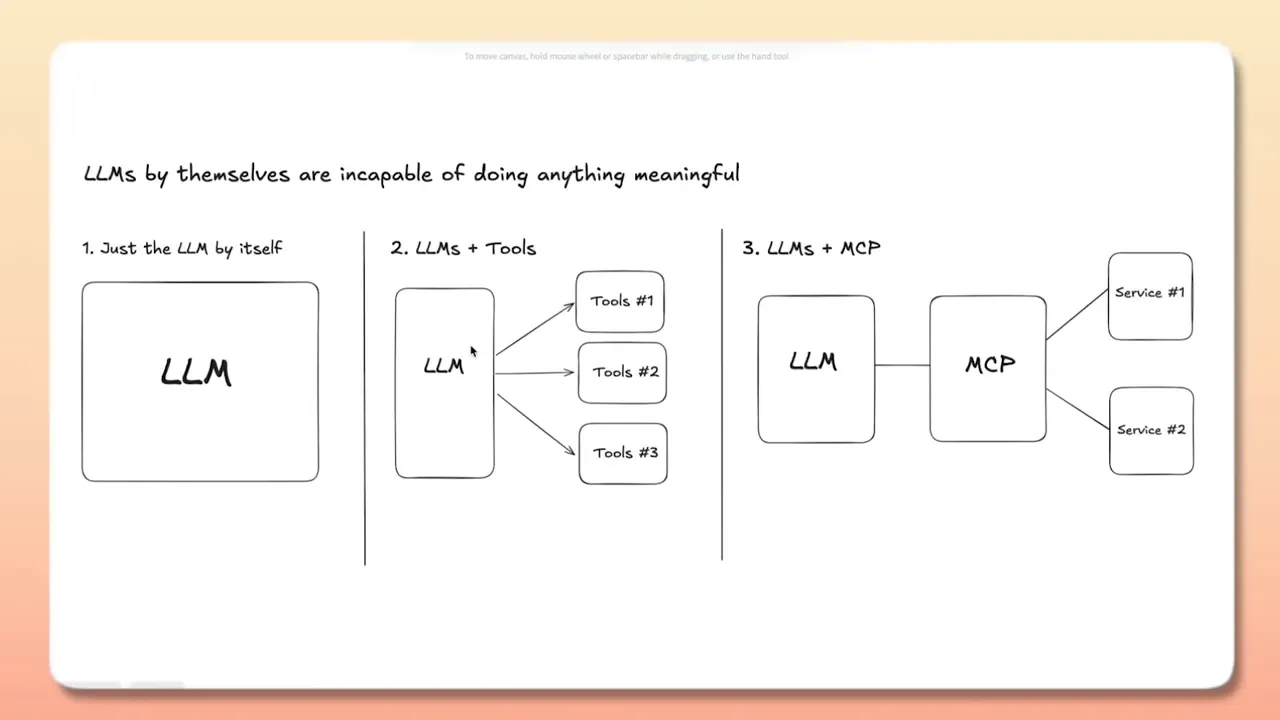
The important shift is not that tools suddenly exist. It’s that developers can work toward a shared connection pattern instead of treating every integration as a completely separate project.
Why Connecting AI Tools Gets So Messy
Engineers love standards because standards make communication between systems easier.
REST APIs are a familiar example of shared conventions for building services. You don’t need to understand their technical details to appreciate the benefit: developers have a recognizable way to interact with another company’s software.
But shared conventions don’t make every API identical. Each service still has its own capabilities, required information, and implementation details.
Here’s the simple analogy: imagine one tool speaks English, another speaks Spanish, and another speaks Japanese.
You can build a connection to each one. It works. But every connection needs its own translation work, and the complexity grows as you add more services.
Now add maintenance.
Imagine a workflow where an incoming Slack message gets read by an AI application, which then sends you a text. Sounds trivial, right?
What happens when Slack changes its API? Or the text messaging service changes something? What if that workflow feeds into three other automations?
A change in one place can create problems elsewhere. Someone has to understand the dependencies, update the integration, and make sure the whole thing still works.
Meanwhile, the AI can make mistakes. Developers also need to keep the model from inventing information, choosing the wrong action, or mishandling a tool’s response.
This integration and coordination work is one reason a dependable, Iron Man style Jarvis assistant is so difficult to build. Connecting a few tools is achievable. Making a broad assistant feel fast, cohesive, and reliable takes serious engineering.
What Is Model Context Protocol?
Model Context Protocol is a standard for connecting AI applications to external tools and data sources.
Using the language analogy, think of MCP as a shared communication layer. Instead of the AI application needing a different connection pattern for every service, those services can expose capabilities through a common protocol.
“Universal translator” is a useful mental model, with one important clarification: someone still has to implement the translation. MCP defines the shared way the pieces communicate. It doesn’t automatically turn every existing API into an AI tool.
For example, imagine an assistant connected to a database service such as Convex or Supabase through an appropriate MCP server. You ask it to create a new database entry.
The application has a standardized way to access the capability exposed by that server, rather than needing an entirely bespoke integration path for that service.
The underlying database still exists. Its API still exists. The work of exposing the right operations still exists. MCP makes the interface between the AI application and those capabilities more consistent.
If you want to go beyond the analogy, the official Model Context Protocol documentation provides the technical reference.
The MCP Ecosystem: Four Pieces to Understand
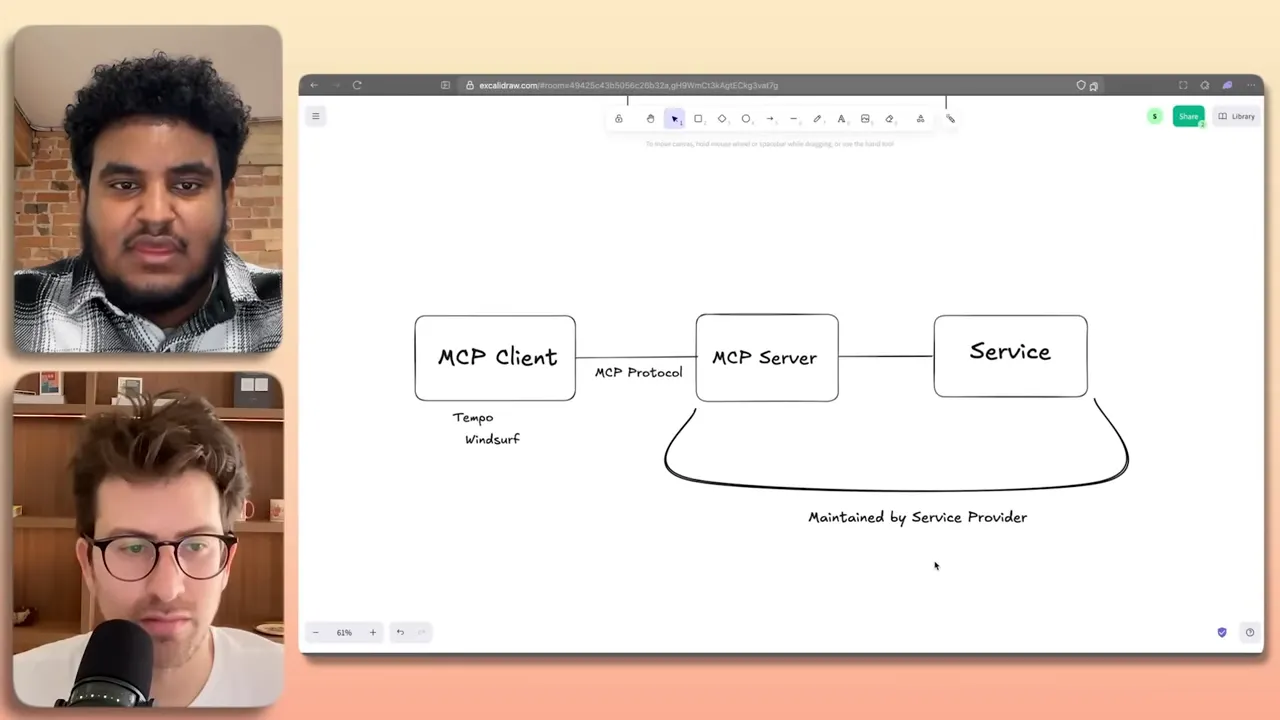
You don’t need a computer science degree to understand the basic architecture. There are four pieces worth keeping straight.
1. The MCP client
The client is the AI application side of the connection. Products such as Tempo, Windsurf, and Cursor illustrate the kind of application where these connections become useful.
More precisely, the application contains the client functionality that connects to an MCP server. For a nontechnical mental model, this is the side closest to the model and the person using it.
2. The protocol
The protocol defines the shared communication rules between client and server.
It is the common language that makes the connection understandable on both sides, rather than another custom arrangement that every application has to invent.
3. The MCP server
The server exposes an external service’s capabilities to the client through MCP.
Think of it as the adapter between the shared protocol and the particular service. It makes the relevant capabilities available in a form the client can work with.
4. The service
The service is the underlying system that does the work or holds the data. It might be a database, a search service, or another external tool.
The simplified flow is:
AI application with an MCP client → MCP protocol → MCP server → external service.
Why Service Providers Matter So Much
One of the smartest parts of Anthropic’s approach is the incentive it creates for service providers.
Imagine we’re building a database company. We want people’s AI applications to use our database. Under this architecture, we can build an MCP server that exposes our service’s capabilities.
Instead of every AI application developer doing all the service-specific integration work independently, the provider can take responsibility for making its product accessible through the shared standard.
That’s a clever move. The model ecosystem becomes more capable, while service providers have a reason to contribute the connections that make it useful.
It also helps explain the interest in MCP server repositories. They’re the practical pieces that connect the standard to real services.
There’s nothing supernatural happening here. A provider can still construct its underlying systems however it wants. But if it wants other developers and businesses to connect easily, offering a familiar interface helps.
The significance comes from adoption. A standard becomes valuable when enough applications and services agree to use it.
What MCP Does Not Magically Fix
It’s not all sunshine and rainbows.
The early setup experience described here involves downloading software, copying configuration, moving files, and dealing with local components. That’s friction, especially for someone who just wants an assistant to work.
It’s also important not to confuse a standardized connection with a flawless product.
- Setup still matters. Someone has to get the client and server connected correctly.
- Service integration still matters. The MCP server has to expose the underlying capabilities properly.
- Reliability still matters. Connecting tools does not eliminate model mistakes or failed operations.
- User experience still matters. A working prototype is not the same as a fast, cohesive assistant.
Manus illustrates the broader ambition of combining many tools into an assistant. My assessment of that approach is based on public examples rather than hands-on testing, but the engineering burden is easy to recognize: coordinating lots of capabilities requires substantial work.
When a service changes and something breaks, an engineer still has to deal with it.
MCP’s promise is to reduce the repeated, bespoke work around connections. It does not make software maintenance disappear, and it does not remove the need for good engineers.
The Startup Opportunity: An MCP App Store
Whenever a protocol becomes widely adopted, founders naturally ask: what businesses can be built around it?
Protocols such as HTTPS and SMTP have supported enormous ecosystems. That doesn’t mean every new protocol guarantees a giant company. It does make standards worth understanding.
One concrete idea for a technical founder is an MCP app store with a much simpler deployment experience.
There are repositories of MCP servers. The proposed product would turn finding and deploying one into a more approachable workflow:
- Browse the available MCP servers on a website.
- Inspect the associated GitHub code and information.
- Click an install or deploy button.
- Receive a URL for the deployed server.
- Connect that URL to a compatible MCP client.
The opportunity isn’t merely putting links into a directory. The useful part is reducing the distance between discovering a server and actually using it.
That directly addresses the setup frustration. If installation involves a bunch of copying, downloading, and local configuration, making deployment easier is a real problem to work on.
But treat this as a startup hypothesis, not a guaranteed business. The workflow depends on client compatibility and the way the standard develops.
What Nontechnical Founders Should Do
If you’re nontechnical, I wouldn’t interpret MCP excitement as a command to immediately start an MCP company.
The more useful move is to follow the applications building support for it and understand what becomes easier as those connections improve.
In the early-stage environment we’re discussing, there is still uncertainty. The standard could change. Another approach could challenge it. Major platform decisions could affect where developers invest their time.
That uncertainty matters for technical founders, too. Being early is useful only if you’re early to something that customers will actually need.
Here’s what I’d pay attention to:
- Which AI applications support the protocol.
- Which service providers expose useful capabilities through MCP servers.
- Whether setup is becoming easier for ordinary users.
- Whether combining tools produces a reliable experience, not just an impressive demo.
The long-term picture is closer to Lego pieces: capabilities that become easier to connect and combine.
But remember, building a basic chatbot with tools and building a polished product are very different things. You may get a prototype together in a couple of hours. Making it fast, limiting hallucinations, and creating an experience people trust is the hard part.
Understand the architecture now so you can recognize a useful opportunity when it appears. You don’t have to force a business decision just because a technical term is going viral.
The Bottom Line: A Simple Standard With Meaningful Potential
MCP is exciting because it tackles a real bottleneck: AI applications become more useful when they can access external tools, but connecting and maintaining those tools is cumbersome.
The model generates the response. The tools provide access and actions. MCP standardizes how the application connects to those capabilities.
That’s the whole idea.
For developers, it points toward less repetitive integration work and opportunities to simplify the surrounding infrastructure. For nontechnical founders, it’s a reason to learn how the pieces fit together without assuming the hype itself is a business model.
The winning product still needs to solve a problem. A shared standard can make that product easier to build.
|


