I think one of the most valuable people in tech over the next 18 to 24 months will be the marketing engineer. Some people call this a forward-deployed marketer. Others call it an AI growth operator. Call it whatever you want. The name will probably change. The job won’t.
This is the person who can use AI agents to take on work that once required an entire marketing team. Not just produce more content. Build a system that understands customers, runs experiments, improves positioning, and turns what it learns into pipeline.
My bet is that exceptional people doing this work could command $250,000, $500,000, or even more than $1 million a year, whether through a role or their own business. That is a prediction, not a salary benchmark. The reason I’m bullish is simple: every company wants more leads, faster experiments, and smarter marketing without continually adding headcount.
If you’re a marketer, this is a path to becoming much more valuable. If you’re a founder, it solves the problem that comes after building a product: getting people to use it.
Key Takeaways
- A marketing engineer turns customer and market signals into pipeline using AI agents, data, code, and judgment.
- A growth repo preserves customer evidence, brand voice, experiment results, and agent instructions so learning compounds.
- Give every agent a defined job, approval boundaries, and a business metric rather than an activity target.
- Start with one working system and prove its value before expanding into more automation.
Table of Contents
- Every Technology Shift Creates a New Kind of Marketer
- What Does a Marketing Engineer Actually Do?
- Start With a Growth Repo: Your Company’s Marketing Memory
- The Marketing Engineer Tool Stack
- Connect Agents to Live Business Data
- Write a Job Description for Every Agent
- Six Marketing Systems, Illustrated With a Commercial HVAC SaaS Company
- Four Ways to Make Money With Marketing Engineering
- The Simplest Version I’d Build Tomorrow
- A 30-Day Plan to Learn Marketing Engineering
- The Agents Will Become Common. Your Judgment Is the Advantage.
Every Technology Shift Creates a New Kind of Marketer
I’ve started and sold three venture-backed companies across the web, social, and mobile eras. Each time the technology changed, the most valuable kind of marketer changed with it.
Marketing engineering is the next step in that progression. But it doesn’t make everything that came before it irrelevant.
Traditional marketing: Make people care
Think of the Don Draper era. The work centered on storytelling, psychology, and getting a product in front of people through channels such as print and radio.
The best marketers understood what people wanted, what made them insecure, and who they hoped to become. They knew how to package a product so the market paid attention. That skill still matters.
Digital marketing: Acquire customers through measurable channels
The internet brought websites, email, SEO, search ads, social ads, landing pages, and tracking pixels. The advantage shifted toward people who understood funnels, targeting, analytics, and the practical question of what happened after someone clicked.
Marketing became something you could measure and optimize with much greater precision.
Growth hacking: Turn the product into a growth engine
Then marketing moved closer to product. Activation, referrals, onboarding, retention, and pricing became central to growth. Frameworks such as Dave McClure’s AARRR funnel reflected that shift.
The product itself could create the loop that brought in and retained customers.
Marketing engineering: Build a system that keeps learning
A marketing engineer still needs customer understanding, positioning, distribution, and taste. If anything, taste matters more because AI is making average marketing unbelievably cheap.
The new capability is building the system behind the marketing: connecting customer data, interpreting results, shipping landing pages and calculators, and turning raw market signals into content, outbound, positioning, and product ideas.
Marketing engineering uses AI agents, data, code, and taste to build a marketing system that keeps learning. That last part is the important part.
What Does a Marketing Engineer Actually Do?
My definition is straightforward: a marketing engineer turns market signal into pipeline using AI agents, data, code, and taste.
Most companies already have the pieces. They have customer calls, dashboards, a CRM, support tickets, content calendars, and a pile of software subscriptions. What they don’t have is a shared learning system.
Sales hears one version of the market. Support hears another. Product sees usage patterns. Marketing knows what got clicks. The founder remembers the one emotional customer conversation they can’t get out of their head. I’ve been that founder.
Then everyone arrives at the growth meeting with a slightly different version of reality.
The marketing engineer brings those signals together and turns them into action. The advantage isn’t simply doing more work. It is learning the market faster:
- Spot customer pain before competitors do.
- Identify the language that gets qualified buyers to respond.
- Test more positioning and advertising angles.
- Ship useful landing pages, lead magnets, and small tools.
- Feed the results back into the next round of decisions.
As a founder, the question I’d ask is: who is building this growth system for our company? It might be you. It might be someone you hire. But someone needs to own it.
Start With a Growth Repo: Your Company’s Marketing Memory
The first thing I’d build is a growth repo. Yes, it sounds a little nerdy. No, you don’t need to start with an elaborate technical setup.
Create a GitHub repository or simply a structured folder. Call it Growth OS. Its job is to hold the company’s marketing memory.
Most people use AI in disconnected chats. They ask for ten posts, copy one they like into a document, and move on. Next week, the AI effectively starts over. It doesn’t have the founder’s voice, the objections from recent sales calls, or the language that actually generated replies.
The repo fixes that by giving future work somewhere to start.
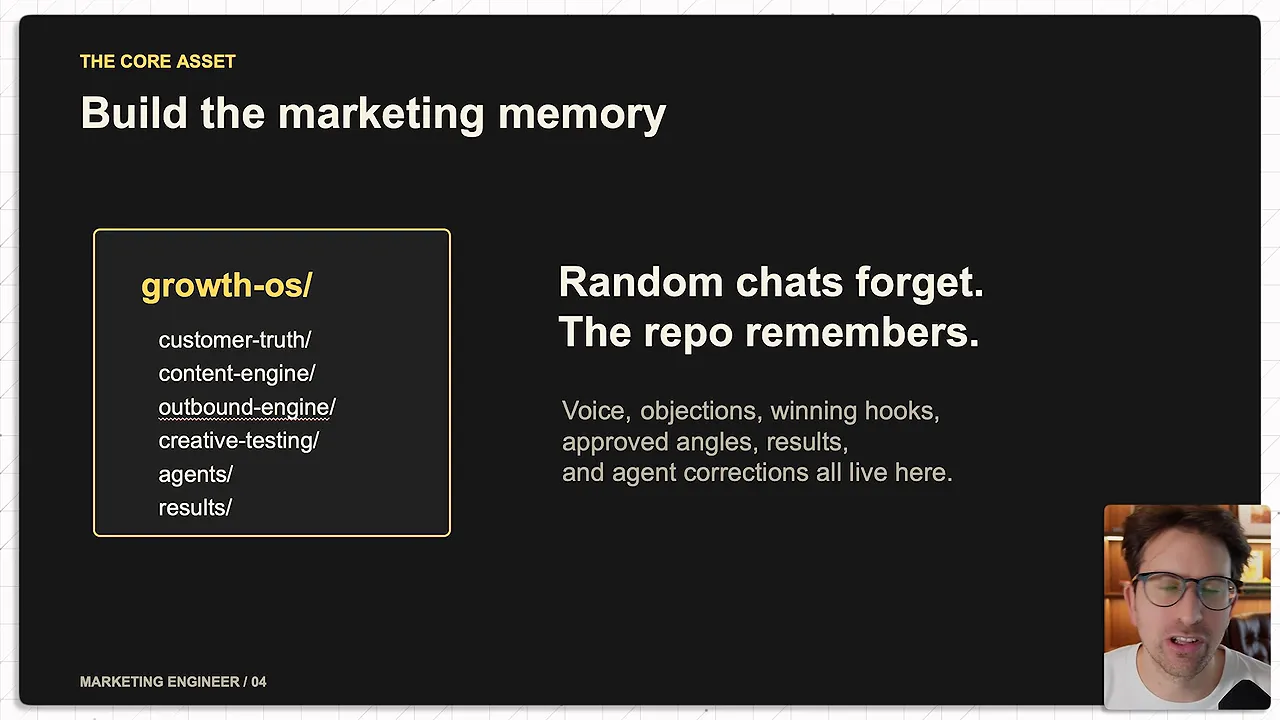
What belongs inside Growth OS?
- Customer truth: Sales call notes, support tickets, churn notes, interviews, and product feedback.
- Content engine: The founder’s voice guide, winning hooks, scripts, and notes on past performance.
- Outbound engine: The ideal customer profile, account research, trigger events, approved angles, and banned language.
- Creative testing: Ad angles, landing page tests, hooks, offers, and results.
- Agent jobs: Written definitions of the work each AI agent performs.
Banned language is worth including. AI outbound gets weird fast when it starts sounding like an overexcited sales rep who just discovered personalization.
This structure also changes how you ask for work. Instead of requesting ten generic LinkedIn posts, you can ask the agent to read the customer truth file, study the founder’s voice, review the last five posts that generated qualified replies, and draft five new posts about pains buyers raised this week.
That is a different level of output because the agent has actual business context. You’ve moved from “AI helped me make something” to “AI is helping the company get smarter.”
The Marketing Engineer Tool Stack
I think about tools by the jobs they do, not as a shopping list everyone must copy. Pick an ecosystem you’re comfortable with. The tools will keep changing. The workflow is the thing to learn.
Grokbot: The market radar
I think of Grokbot as a layer that stays close to the live internet, particularly the X ecosystem. Marketing is a moving system: competitors change their offers, customers change their language, and creators discover new formats.
I’d give agents a few clear lanes:
- Monitor competitors and report what changed.
- Track customer language across X and Reddit.
- Identify creator formats in the niche worth testing.
- Review changes to ads and landing pages.
You can choose to do more within that ecosystem if it suits you. This is how I separate the work, not a rule that every company needs a different tool for every task.
Claude and Codex: The workbench
I use tools such as Claude and Codex to help build the repo, generate landing pages, write scripts, and create small internal tools.
This is where repeatable work becomes something durable. Instead of solving the same problem manually every week, you build the mechanism that handles it.
Hermes-style workflows: Scheduled operations with memory
Scheduled workflows become useful when you want recurring work with memory and approval steps. For example:
- Prepare a market brief every Monday morning.
- Review experiment results every Friday afternoon.
- Extract objections whenever new sales call notes arrive, then propose updates to the positioning file.
Creative models: Faster production and testing
Creative tools such as fal.ai and Higgsfield can help with ads, thumbnails, mockups, and video concepts. Their role is to make creative exploration faster, while your positioning and judgment determine what is worth testing.
Local AI: Sensitive data and cost considerations
Local AI can matter when the work involves private customer conversations, regulated notes, pricing plans, or other material a company is uncomfortable sending into a cloud service. It can also be worth considering for work that becomes too expensive in a cloud tool.
The decision starts with the company’s data requirements and workload, not with collecting another tool.
Connect Agents to Live Business Data
The beginner version of AI-assisted SEO is asking for a blog post about a keyword. A marketing engineer builds a workflow around the opportunity.
That workflow might:
- Check Google Search Console for current search performance.
- Pull keyword data from Ahrefs or Semrush.
- Check the CMS to see whether relevant content already exists.
- Prioritize opportunities by search volume and buyer intent.
- Research the pages already ranking.
- Add the founder’s point of view.
- Draft the article, a title tag, and suggested internal links.
- Send the complete package for approval.
That is a much bigger jump than generating text. The agent has a defined job. Its inputs come from the business. Its output goes somewhere useful.
Write a Job Description for Every Agent
I’d write an agent’s job spec almost as if I were hiring a person. “Help with marketing” is not a job description.
Every agent should have clear answers to these questions:
- Sources: What data does it use?
- Schedule: When does it run?
- Filters: What should it exclude?
- Output: What should it produce, and what does good look like?
- Approval: What requires a human decision?
- Metric: Which business result matters?
- Memory: Where does it write results and lessons for next time?
For example, a competitor-engagement agent could review 20 relevant LinkedIn accounts each weekday, identify people who commented on new posts, enrich those accounts, remove poor-fit prospects, and draft ten messages tied to the specific post each person engaged with. It would save those drafts for human approval.
The metric would be positive replies from qualified accounts, not the number of messages produced.
Messages sent is activity. Qualified replies is signal. The point is to create pipeline, not make a dashboard look busy.
Train agents like new hires
Start with small tasks. Review the work. Correct mistakes. Add the correction to memory. Expand the scope as confidence increases.
- If the outbound agent writes fake-sounding opening lines, add a rule to the repo.
- If the content agent produces generic introductions, give it three good examples and three bad ones.
- If the customer truth agent makes unsupported claims, require a quote, link, or source for every insight.
Every correction becomes part of the operating system. That is how the work compounds rather than resetting each week.
Six Marketing Systems, Illustrated With a Commercial HVAC SaaS Company
Imagine a vertical SaaS startup selling software to commercial HVAC contractors. Its customers manage technicians, service calls, maintenance contracts, and dispatch.
It’s a useful example because the workflows are messy and the buyer’s language is specific. The real marketing question isn’t “How do we create more content?” It’s “Which pain gets an owner to book a demo?”
Maybe it’s dispatch chaos. Maybe it’s late invoices. Maybe the owner can’t tell which jobs were profitable until the month ends.
Or maybe a technician completes a service call, notices an equipment replacement opportunity, and the follow-up quote never gets sent.
Now that’s interesting. A message about recovering replacement revenue lost after service calls is much sharper than a generic promise to improve an HVAC business.
1. The customer truth system
The first system brings customer evidence into one place. Its output is a Markdown file with a name like what-the-market-is-telling-us.md, updated daily or weekly depending on how much signal the company generates.
It draws from sales calls, support tickets, churn notes, CRM notes, payment changes, product behavior, and relevant social data. Its job is to show what changed, not simply summarize everything.
Are buyers using a new phrase? Are trial users repeatedly getting stuck before inviting a teammate? Is one pain associated with conversions rather than just being mentioned frequently?
The memo needs receipts: quote snippets, ticket links, and event counts. “Customers want better collaboration” is too vague to act on.
In our hypothetical HVAC company, a useful memo might report that five sales calls mentioned emergency dispatch, but the calls that converted all focused on follow-up quotes missed after a technician left the job.
That is sharper. It gives the team something to test and makes the business harder to lie to.
2. The founder content engine
Companies often have great raw material that never becomes useful marketing. The founder has opinions. Customers have stories. Calls and podcast conversations contain strong ideas.
The marketing engineer captures that material, extracts the strongest insights, turns them into content, and tracks which hooks and formats perform.
The missed-replacement-revenue insight could become five assets:
- A founder post about a hidden revenue leak in service businesses.
- A short video explaining why money gets lost after the first visit.
- A landing page message connecting completed jobs to follow-up quotes.
- A cold email angle built around missed replacement opportunities.
- A calculator estimating the revenue lost through incomplete follow-up.
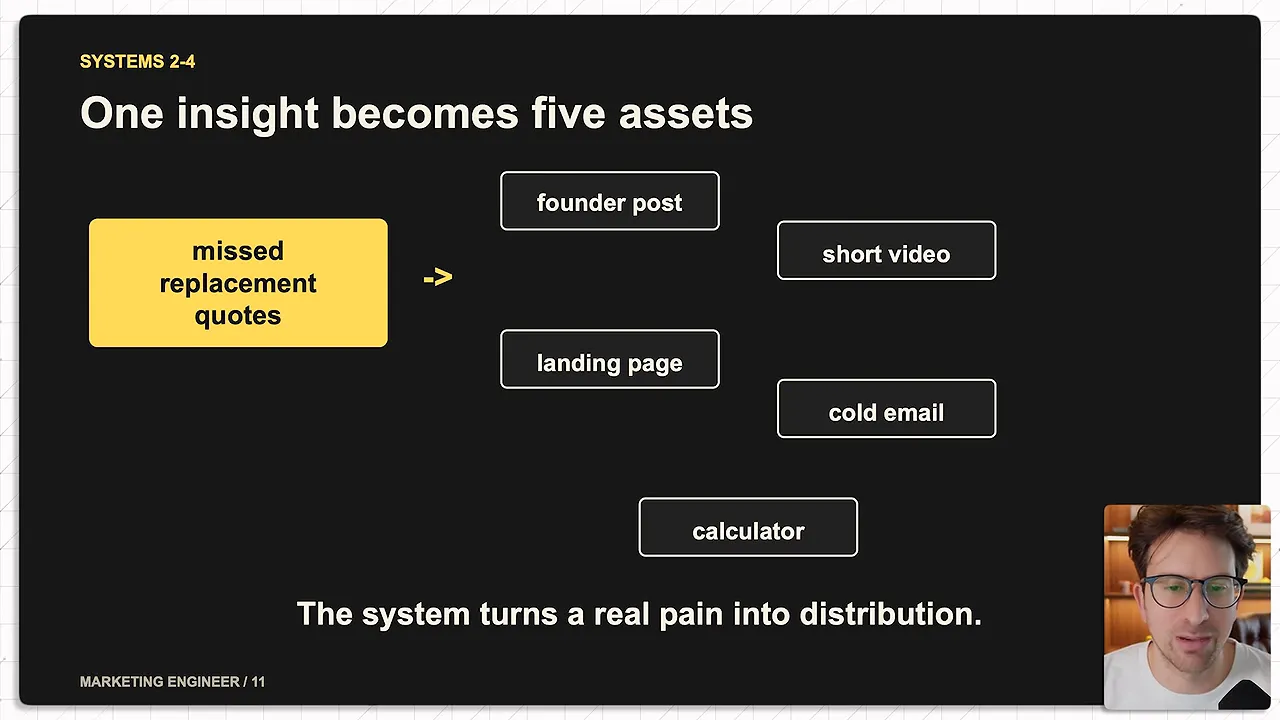
The system turns one real customer pain into distribution, then learns from the response. It isn’t just repurposing content for the sake of filling a calendar.
3. The outbound signal engine
Bad outbound usually starts with a spreadsheet of names. Good outbound starts with timing.
Who just raised money? Who is hiring to solve the exact problem your product addresses? Who publicly described a relevant pain? Who fits the ideal customer profile and has a reason to care this week?
For the HVAC company, useful signals could include contractors hiring dispatchers, opening new locations, or receiving reviews that reveal operational problems.
The agent monitors signals, researches accounts, drafts specific outreach angles, and sends them for approval. The goal is to reach a good-fit buyer when the problem matters, not manufacture a flimsy excuse for personalization.
4. The creative testing engine
Take one offer. Develop 20 hooks and ten ad angles. Test them, record the results, and use those results to inform the next batch.
When someone says Facebook ads don’t work for their business, maybe they’re right. Or maybe they haven’t tested enough creative with the right angle.
A marketing engineer can use agents and creative models to explore many variations grounded in actual positioning. As customer signals and performance data change, the next round changes too.
Creative becomes a learning system instead of an endless production treadmill. Producing thousands of assets isn’t the goal by itself. Learning which message creates demand is.
5. AI search visibility
Buyers increasingly ask AI systems for recommendations, explanations, and comparisons. That creates another marketing surface.
A marketing engineer asks whether those systems can understand the company, its product, and the problem it solves. Agents can help gather relevant information, identify content opportunities, and propose website improvements aimed at making the company a useful source.
The opportunity is to be cited when buyers ask relevant questions. It’s not just about producing more pages. It’s about making the company understandable and worth referencing.
6. The growth cockpit and evaluation loop
The growth cockpit is the weekly view of what changed and what the team should do about it.
It should answer questions such as:
- Which content worked?
- Which campaigns created real conversations?
- Which objections kept appearing?
- Which experiments won, and what percentage of tests succeeded?
- What changed among competitors?
- Which customer pain is getting louder?
- What should we test next?
For our hypothetical HVAC company, the cockpit might show that the replacement-revenue angle generated fewer clicks than the dispatch angle but twice as many demo requests from owners with more than 20 technicians.
That is the kind of finding an executive wants. It separates attention from business value and tells the team where to point the next experiment.
Four Ways to Make Money With Marketing Engineering
1. Become the person inside the company
If you’re already in marketing, growth, RevOps, or content, this is a direct path toward more valuable work because it sits next to revenue.
Generating pipeline, improving conversion, and reducing wasted spend create a clear business case. That is the logic behind my compensation prediction. A company can justify a highly paid hire when the value created is substantially larger than the cost.
The title alone won’t get someone a $500,000 role. The measurable impact is what makes the argument.
2. Consult and build one system
You can embed with a company for 30, 60, or 90 days and sell a defined outcome:
- Build a customer truth system and turn its findings into weekly campaigns.
- Build a founder content engine.
- Build an outbound signal engine.
Depending on the scope and value of the work, I can see offers priced at $5,000, $10,000, or $30,000 a month. Those are possible offer structures, not guaranteed earnings.
3. Create a productized service
Pick one narrow problem for one specific customer and repeat the delivery.
That could mean outbound signal engines for vertical SaaS, founder content engines for B2B CEOs, or customer truth repos for seed-stage startups before they hire a full marketing team.
The tighter the focus, the easier it becomes to sell, deliver, and repeat. You aren’t doing custom everything for everyone. You do one thing for one niche at a defined price.
4. Turn repeated pain into software
I think software could produce the largest outcomes, but I would start with services.
Build the system for five or ten companies. Notice what repeats. Then turn that recurring need into software or a set of agents.
These paths stack together: consulting teaches you what works, repetition reveals a productized service, and repeated delivery can expose the software opportunity. It’s a much better starting point than building something nobody wants.
The Simplest Version I’d Build Tomorrow
Keep the first version almost painfully simple.
Create the Growth OS folder with files for customer truth, founder voice, experiments, and agent jobs. Add 20 real customer notes or call summaries.
Then give the agent one assignment:
Identify what changed, show the supporting evidence, and recommend one marketing test that could create pipeline this week.
Build one thing from that output. For the HVAC company, it might be the lost replacement revenue calculator.
The first goal is not to automate the entire marketing department. It is to prove that the system can turn messy market data into one useful action.
A 30-Day Plan to Learn Marketing Engineering
You don’t need to master every tool before starting. You need one real company, access to useful signals, and a commitment to finishing one working system.
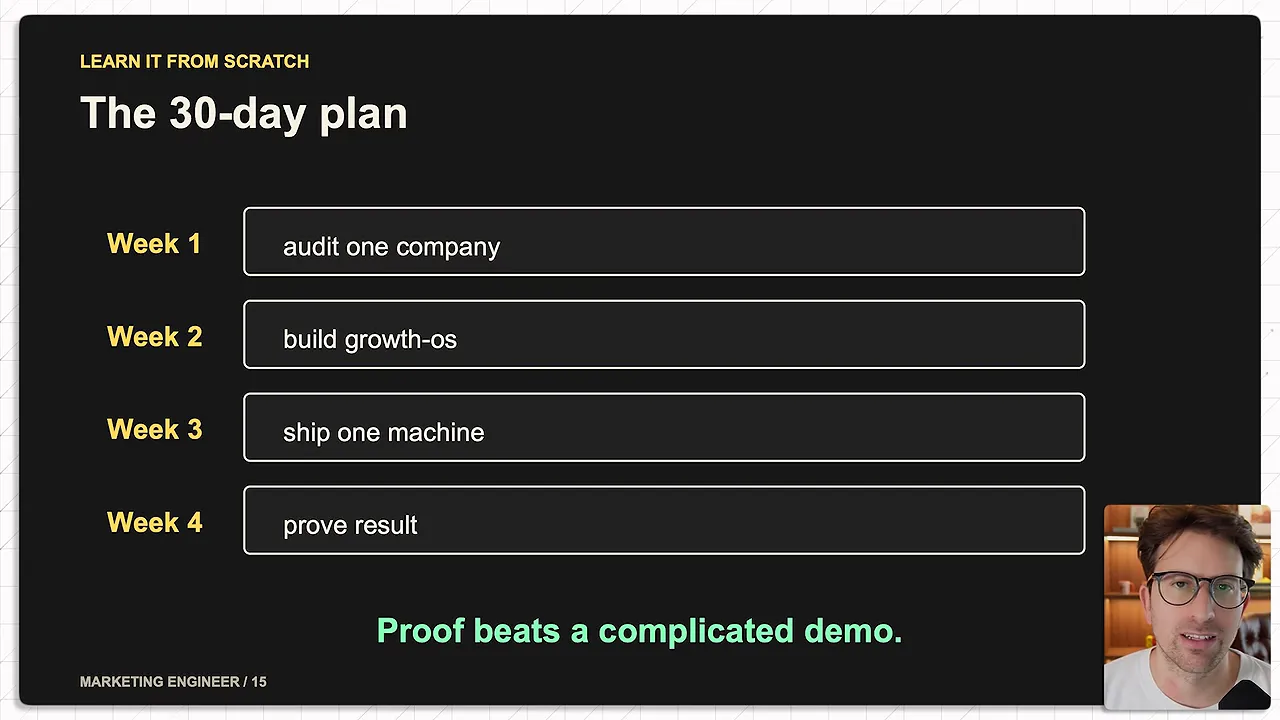
Week 1: Audit one real company
Choose your company, a friend’s business, or another company you can meaningfully study. Review its website, offer, ideal customer profile, founder content, and any sales calls or support tickets you can access.
Your output is a market map answering:
- Who is the customer?
- What pain do they describe, and what words do they use?
- What are they buying instead?
- Where is the funnel leaking?
- What would you test first?
Week 2: Build the growth repo
Create the folders, organize the evidence, and produce the first market truth memo.
Use Claude, ChatGPT, Grokbot, Gemini, or local models. The tool matters less than the workflow. The goal is to turn scattered signals into a useful memo with evidence behind its conclusions.
Week 3: Build one working machine
Choose the system the company most needs: a content engine, an outbound signal engine, or a landing page testing workflow.
Pick one. One working system beats five half-built ones.
Week 4: Measure results and write the case study
What changed? Did qualified replies improve? Were meetings booked? Did conversion increase? Did the founder’s content become sharper and more useful?
At the end of the month, you want a case study with a concrete chain of evidence. A hypothetical example could be:
You audited a company’s growth, built a customer truth repo, identified an overlooked high-intent pain, and turned it into an outbound signal engine. That engine supported 75 targeted messages, generated nine warm replies, and booked three calls. You documented what worked and what you learned.
Those numbers are illustrative. The point is the structure: insight, system, action, result, learning.
That is how you establish credibility with employers or clients. Proof beats a complicated demo.
The Agents Will Become Common. Your Judgment Is the Advantage.
The best marketing engineers will feel like part marketer, part product person, part RevOps specialist, part data analyst, part creator, and part engineer.
They can talk to a customer, find the useful insight, write the positioning, wire the automation, build the landing page, read the conversion data, and recognize when an outbound message sounds fake.
AI helps them make more. Judgment tells them what should exist in the first place.
That’s the real opportunity. As agents become more widely available, access to them becomes less of an advantage. Knowing what to point them at becomes more valuable.
The window is open because many companies still haven’t built the learning system. Start with customer evidence. Build one useful workflow. Measure whether it creates pipeline. Put the lesson back into the repo.
That is marketing engineering: not simply doing marketing faster, but building marketing that gets smarter every week.


